
Email: [email protected]

 English
  español
Industry News
HOME / NEWS / Industry News / Rolling Tool Bag Buying Guide: Key Specs, Materials, and Sizing for Professionals
HOME > NEWS > Industry News > Rolling Tool Bag Buying Guide: Key Specs, Materials, and Sizing for Professionals
Rolling Tool Bag Buying Guide: Key Specs, Materials, and Sizing for Professionals
 2026.08.19
 Industry News
Dragging a half-loaded tool bag should not require a second person. Yet many technicians end up wrestling with a rolling bag that tips over, catches on curbs, or loses its handle in the middle of a job. A rolling tool bag is not simply a tote with wheels attached; it is a package built around a load-bearing base, wheel geometry, fabric strength, and handle ergonomics. Decide on those four points first, and every other buying detail becomes easier to evaluate.
Why a Rolling Tool Bag Earns Its Place
A rolling tool bag is a practical choice for work that requires moving tools between storage and job sites. It keeps the weight on the wheels instead of on your back, which matters when the load reaches 20 kg or more. On smooth floors, a wheeled bag moves quickly and leaves both hands free for materials or a ladder.
The trade-off appears on stairs, gravel, and uneven ground. Two wheels and a pull handle work well on level surfaces; four small swivel wheels turn nicely indoors but are weaker on rough terrain. That is why the decision is really about route conditions. If your typical day starts in a van and ends on a clean concrete floor, a rolling bag is an easy win. If you climb ladders or stairs all day, a backpack might be better for the vertical parts.
The Critical Components That Determine Durability
The most important part of a rolling tool bag is not the brand patch or the price tag. It is the structural bottom that takes the load, the fabric that resists abrasion, and the wheels that carry everything every day. These three elements decide whether a bag lasts five years or five months.
Fabric Weave and Denier
Fabric weight is expressed in denier. A 600D polyester bag is the standard starting point for general use; it is light, relatively affordable, and good enough for occasional transport. A 1680D polyester or nylon shell is heavier and noticeably more resistant to cuts from sharp tools and tears from rough concrete. For a rolling bag that is dragged daily, 1680D reduces the chance of a side seam splitting when the bag is packed full. The weave density also matters: a tight weave will feel crisp to the touch, while a loose weave will show the fabric structure and wear faster.
Molded Base and Bottom Protection
The molded base is the skeleton of the whole bag. In well-made rolling tool bags, a sheet of polyethylene or polypropylene is heat-pressed into a rigid tray that supports the bag's full footprint. That tray prevents the bag from bulging sideways, protects the contents from moisture on wet floors, and keeps the bag upright when you need to set it down. A good base also extends the life of the zippers because the fabric is not constantly stretching against the load.
To judge the base, press on the empty bag from the inside. If the bottom flexes easily, it will struggle with a quarterly load of heavy power tools. For a bag that has to absorb heavier abuse, our 18-27 inch pull rod tool bag uses a molded plastic base and a reinforced steel pull rod, which is a combination we recommend when the expected load goes beyond 20 kg.
 Rolling Tool BagThe Trolley Tool Bag...View Product →
Wheel, Handle, and Frame
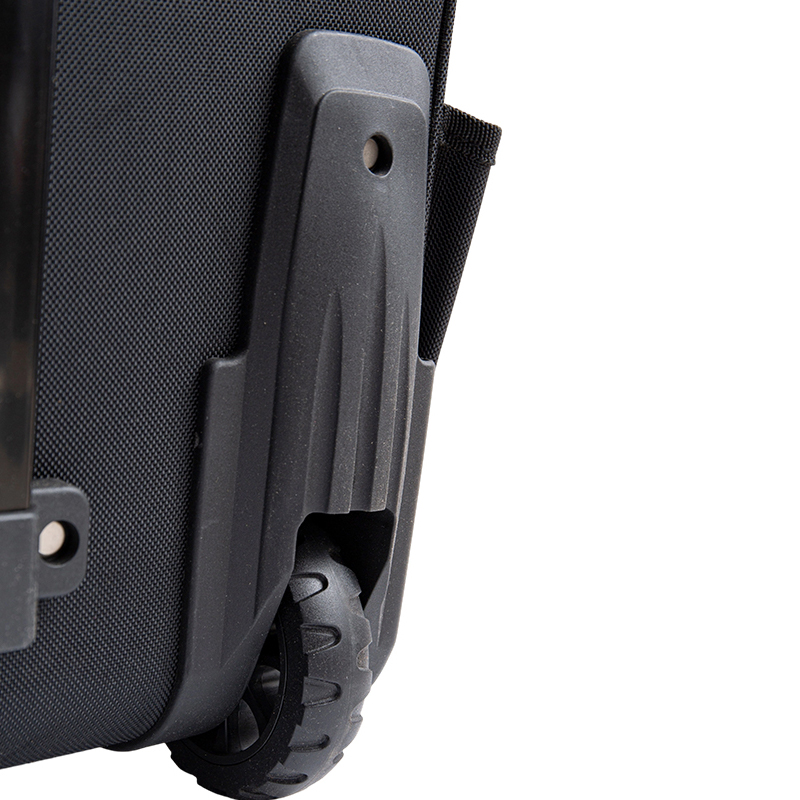
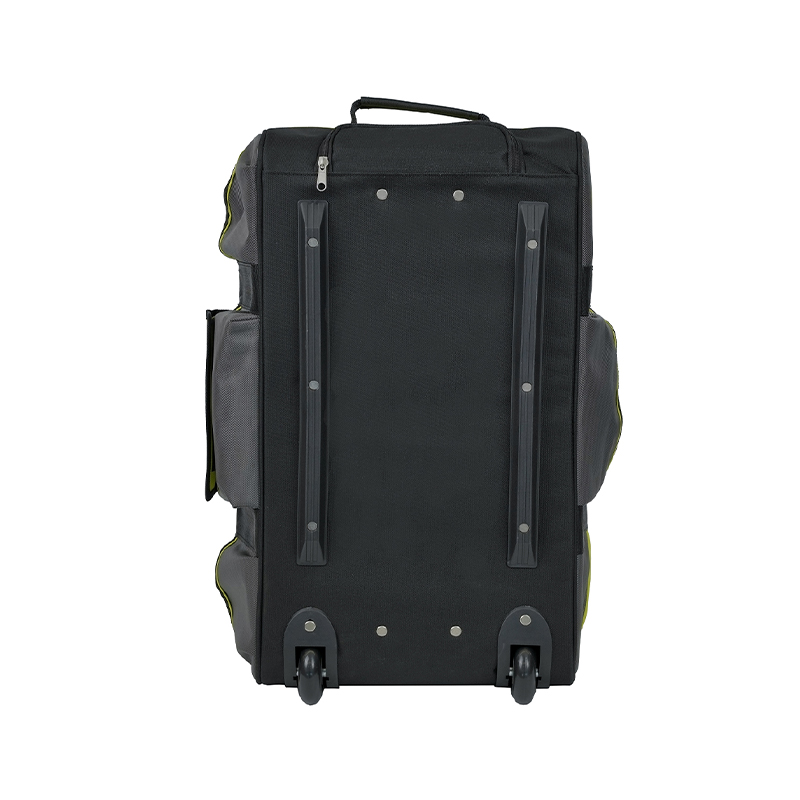
Wheel design is often overlooked. Two fixed wheels provide a narrow footprint and are lighter, but four swivel wheels make a bag easier to steer around equipment and corners. Wheel diameter matters just as much: larger wheels roll over threshold strips and gravel without jamming, while small wheels tend to stall on any obstacle. A handle should be a telescopic steel or aluminum tube with a positive locking button, not a thin plastic rod. The handle attachment points should be riveted or bolted through a reinforced internal plate, otherwise the screw threads pull out under repeated lifting.
Zippers and Stitching
Zippers take constant stress on a loaded bag. A wide zipper tape with a metal slider is more dependable than a narrow nylon coil. Run your hand along the zipper from the outside; if the tape feels thin and wavy, it will likely split when the bag is packed to its intended capacity. Stitching should be double-stitched at stress points, especially the handle attachment, wheel housings, and bottom seam. Look for a lock-stitch on the main seam; a chain-stitch can unravel quickly if one thread breaks.
Matching the Bag to Real Work Conditions
Once you know the construction quality, the next stage is fitting the bag to the actual tools you carry. A giant bag with every pocket filled is still a bad choice if it forces you to work from a bag that is too heavy to lift into the van.
Size and Capacity
Rolling tool bags typically range from 14 to 27 inches in height or width, depending on the brand. A 14-inch bag suits light service calls, a compact drill set, or a small electrical kit. An 18-inch bag is the most common choice for electricians and general technicians who need a balanced mix of hand tools and test equipment. A 22-inch or larger bag works for maintenance crews that carry power tools, spare parts, and personal safety gear.
It is also worth thinking about where the bag will live when it is not on the job. A compact 14-18 inch model stores easily under a workbench or behind a van seat. Our 14-18 inch 1680D pull rod tool bag is a good example of this middle size: it offers enough room for a complete hand tool set, yet it does not dominate the space where it is stored.
 Rolling Tool BagThe Trolley Tool Bag...View Product →
Pocket Layout
Rather than counting pockets, plan them around how you work. Large open compartments carry drills, impact drivers, and boxes; smaller gusseted pockets on the sides hold screwdrivers, pliers, and testers. A few pockets inside the main compartment are useful for keeping small parts separate. Outside pockets offer quick access to the tool you use most often, so you avoid opening the main cover on a dirty floor. Some technicians also prefer a flat, padded top that can serve as a temporary seat or makeshift work surface.
Weight Distribution and Mobility
A bag loaded to its rated capacity will behave badly if the weight sits too high or too far off the wheel axis. The bag should stay upright when you stop, and it should not tip backward when you release the handle. Check the distance between the wheels; a wider wheelbase gives more stability. Also test the handle length while the bag is loaded. If the handle is too short, your wrist will hit the bag when you pull; if it is too long, the bag will tend to swing.
For heavy loads, we reinforce the handle and wheel mounts. One of the models we manufacture, the 18-22 inch large capacity trolley tool bag, uses a telescopic steel handle and large wheels to keep the bag balanced on factory floors and warehouse lanes. That design is a reliable option for an environment where the bag is more likely to roll on flat ground than to climb stairs.
 Rolling Tool BagThe Trolley Tool Bag...View Product →
Quick Reference Specifications
The table below summarizes the most common rolling tool bag configurations we see in professional use. It is a starting point for comparing models; your own weight limit will depend on the tool set and the terrain you cover.
| Bag Size | Typical Fabric | Bottom | Wheel Type | Carrying Load |
|---|---|---|---|---|
| 14-18 inch | 600D or 1680D | Molded plastic | Two fixed or four swivel | 10-18 kg |
| 18-22 inch | 600D or 1680D | Reinforced molded base | Two fixed, large diameter | 15-25 kg |
| 22-27 inch | 1680D or 600D | Heavy-duty molded base | Four swivel or two fixed | 20-35 kg |
What the Manufacturer Looks at Before Sending a Bag Out
From the production side, approving a rolling tool bag model involves more than checking a sample. We test zipper cycling, wheel rotation, handle locking, and the bottom tray's resistance to impact. The same level of attention applies when you buy from any manufacturer. Ask for the ISO 9001 certificate, confirm that fabric suppliers meet REACH restrictions, and request a pre-shipment inspection if possible. A more detailed technical guide on choosing rolling tool bags can help you match inspection criteria to the way the bag is used.
For buyers who source in volume, the key is consistency between batches. Check stitch density, color fastness, and how the wheel brackets are attached. These small details determine whether a bag survives long-term warranty claims or becomes the source of customer complaints. If you need logo printing, custom pocket layouts, or a thicker bottom tray, those changes should be confirmed during the sample stage so they are reflected in every production batch.
Maintenance That Extends a Rolling Tool Bag's Life
Rolling tool bags last longer when they get basic care. Wipe dust and debris off the wheel axles after a heavy week; a clogged wheel is a common reason a bag suddenly stops rolling smoothly. Close zippers before lifting the bag by its handle, because an open zipper puts uneven stress on the teeth and can cause the track to separate. Store the bag upright or on its back, not on its side, so the molded base stays flat and does not warp under uneven load. If the bag gets wet, dry the interior before closing it, especially if the bottom tray has any drainage holes or seams.
A rolling tool bag is a workhorse, not a status symbol. The right one will carry twenty kilograms without sagging, roll smoothly through the tightest corridor in the building, and keep its zippers aligned after months of abuse. Start with the base, wheels, fabric, and handle, and the rest of the list sorts itself out. Whether you are buying one bag for yourself or a thousand for a distribution channel, those four components will always tell you how long the product will last.
Related Products

Yancheng Tengchi Tourism Products Co., Ltd. It is dedicated to
designing and producing high-quality tool bags, including
heavy-duty electrician bags.
Experienced staff and experts are always available to provide
you with professional guidance and solutions to technical
problems.
- Product
- Tool Bag
- Tool Backpack
- Capabilities
- Capabilities
- Custom
- About US
- About Tengchi
- Certification
- Quick Connect
- Custom
- Capabilities
- Contact



