
Email: [email protected]

 English
  español
Industry News
How to Measure a Suitcase, Tool Bag and Tool Backpack
 2026.05.27
 Industry News
How to Measure a Suitcase, Tool Bag, or Tool Backpack: The Quick Answer
To measure a suitcase, tool bag, or tool backpack, use a measuring tape and record three dimensions: height × width × depth (in inches or centimeters). For suitcases, measure the exterior including wheels and handles. Add all three numbers together to get the linear inches — airlines typically allow a maximum of 62 linear inches (about 158 cm) for checked luggage. For tool bags and tool backpacks, measure the main compartment interior for capacity planning, and the full exterior for storage shelf or vehicle fitting.
These three steps apply to all bag types:
- Place the bag on a flat surface in its natural upright position.
- Measure height (top to bottom), width (left to right), and depth (front to back).
- Note whether you need interior or exterior dimensions depending on your purpose.
How to Measure a Suitcase: Step-by-Step
Measuring a suitcase correctly is critical — especially for air travel where size limits are strictly enforced. Most travelers measure incorrectly by ignoring protruding parts, resulting in unexpected fees at the gate.
Exterior Measurement (for Airline Compliance)
Airlines measure the total exterior dimensions, including all protruding elements:
- Height: Measure from the bottom of the wheels to the very top of the extended telescoping handle.
- Width: Measure the widest point, including any side pockets or handles.
- Depth: Measure from the front face to the back, including any expansion zippers when fully expanded.
Add the three numbers together for your linear inches. For example: a suitcase measuring 27" × 19" × 14" = 60 linear inches, which fits within most airlines' 62-inch checked bag limit.
Interior Measurement (for Packing Capacity)
Interior dimensions tell you how much you can actually pack. Open the suitcase fully and measure each dimension inside the main compartment. Manufacturers often report interior volume in liters — a typical carry-on holds 35–45 liters, while a large checked bag holds 75–115 liters.
Standard Suitcase Size Reference
| Size Category | Typical Height | Linear Inches | Common Use |
|---|---|---|---|
| Carry-On | 18"–22" | 40–45 linear in. | Short trips, overhead bin |
| Medium Checked | 24"–25" | 55–60 linear in. | 1–2 week trips |
| Large Checked | 28"–32" | 60–62 linear in. | Extended travel, family trips |
Airline Size Rules You Must Know
Airlines vary significantly in their size policies. Misreading them can cost you $30–$200 per bag in fees. Here are the most common rules:
- Checked bags: Most major carriers (Delta, United, American) allow up to 62 linear inches and 50 lbs (23 kg).
- Carry-on bags: Typically limited to 22" × 14" × 9" (including handles and wheels) for most U.S. carriers.
- Budget airlines (Spirit, Frontier, Ryanair): Much stricter — some limit carry-ons to 18" × 14" × 8" or charge fees for anything larger than a personal item.
- Oversize checked bags (63–115 linear inches) incur fees of $100–$200 per bag on most carriers.
Always verify your specific airline's policy before traveling, as these limits are updated regularly.
How to Measure a Tool Bag
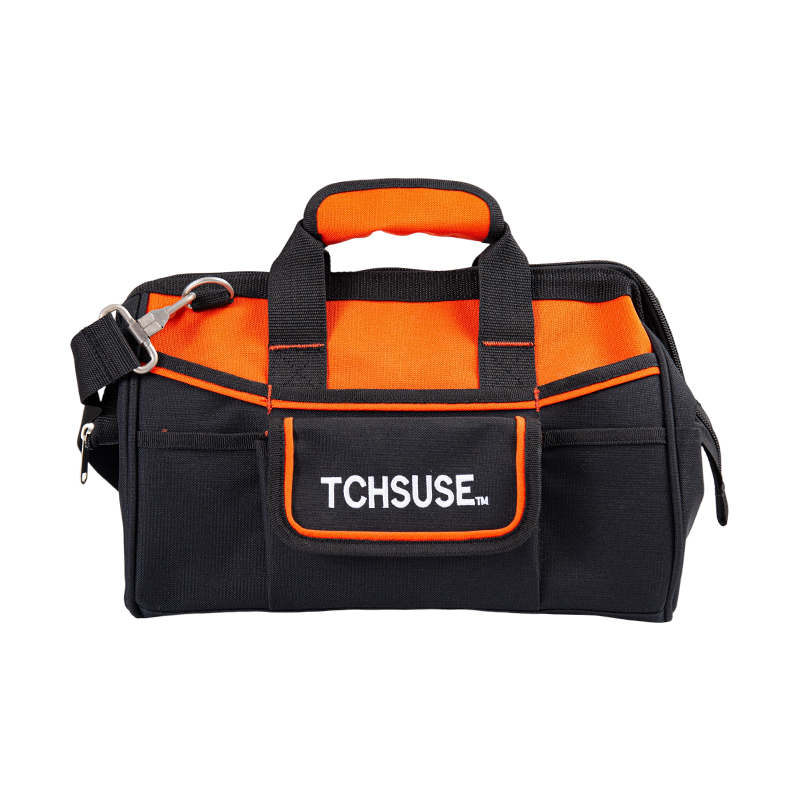
A tool bag is a structured, open-top or zippered bag designed to carry hand tools, power tool accessories, and hardware. Unlike suitcases, tool bag measurements are most useful for storage fit and transport planning — not airline compliance.
Key Dimensions to Measure on a Tool Bag
- Overall Length (Width): Measure the longest side of the base, from one end to the other. This is the most commonly advertised dimension — e.g., "18-inch tool bag."
- Height: Measure from the base to the top of the open mouth (not the handle). This tells you how tall your tools can be before sticking out.
- Depth (Front to Back): Measure the shorter base dimension. A wider base provides more stability and storage.
- Interior Pocket Dimensions: For specialty tools (screwdrivers, chisels, pliers), measure individual pocket heights and widths to ensure fit.
A standard 18" open-top tool bag typically measures approximately 18" L × 10" H × 9" D and can hold around 30–50 lbs of tools depending on construction. Heavy-duty canvas bags with reinforced bases handle up to 75 lbs.
Tool Bag Sizes Compared
| Bag Size | Dimensions (L×H×D) | Best For | Capacity |
|---|---|---|---|
| Small (12") | 12" × 8" × 6" | Electricians, light kits | 10–20 lbs |
| Medium (18") | 18" × 10" × 9" | General contractors | 30–50 lbs |
| Large (24") | 24" × 13" × 11" | Plumbers, HVAC techs | 50–75 lbs |
How to Measure a Tool Backpack
A tool backpack differs from a standard tool bag in that it distributes weight across both shoulders, making it ideal for technicians and tradespeople who travel on foot between job sites. Measuring a tool backpack correctly helps you evaluate fit, storage capacity, and airline carry-on suitability.
How to Measure a Tool Backpack's Dimensions
- Stand the backpack upright on a flat surface with all compartments empty and zippers closed.
- Height: Measure from the bottom to the very top, including any top handles or loops.
- Width: Measure the widest point across the front face, usually at mid-height.
- Depth: Measure from the back panel (where it rests against your back) to the front face at its deepest point.
- For interior capacity, open each main compartment and measure height, width, and depth separately.
Most professional tool backpacks range from 18" to 22" tall, 12" to 15" wide, and 7" to 10" deep. Their capacity typically falls between 30 and 60 liters.
Can a Tool Backpack Be Used as a Carry-On?
Many tool backpacks fall within airline carry-on limits (22" × 14" × 9"), but you must also consider weight — most airlines cap carry-ons at 15–25 lbs (7–11 kg). A fully loaded tool backpack can easily exceed 40 lbs, so check both size and weight before heading to the airport. Certain tools (blades, drill bits over a certain length) may also be restricted by TSA regulations regardless of bag size.
Tool Bag vs. Tool Backpack: Which Measurement Matters More?
The right measurement focus depends on how you use the bag:
| Scenario | Tool Bag Priority | Tool Backpack Priority |
|---|---|---|
| Fitting in a vehicle trunk | Overall length × depth | Height × depth |
| Storing on a garage shelf | Length × height | Height × width |
| Air travel (carry-on) | All 3 exterior dims + weight | All 3 exterior dims + weight |
| Daily job site carrying | Weight capacity | Torso length fit + capacity |
For tool backpacks worn all day, also consider torso length compatibility. Most adjustable tool backpacks accommodate torso lengths from 16" to 21". Measure your torso from the C7 vertebra (the bony bump at the base of your neck) to your iliac crest (the top of your hip bone) to find your size.
Common Measurement Mistakes and How to Avoid Them
Even experienced travelers and tradespeople make avoidable errors when measuring bags. Here are the most frequent mistakes:
- Ignoring wheels and handles on suitcases: Airlines include all protrusions in their measurement. A 27" suitcase body with 2" wheels and a 4" handle extension is effectively 33" tall when measured properly.
- Measuring a full bag: Always measure bags when empty. Overpacking distorts the shape and can cause soft-sided bags to exceed their advertised dimensions by 1–3 inches.
- Confusing interior and exterior dimensions: Manufacturers advertise varying dimensions depending on brand. Always confirm which is being listed. A bag listed as "18-inch" may refer to the exterior length, while the interior depth could be only 16 inches.
- Not accounting for expansion zippers: Many suitcases and tool bags have expansion zippers that add 1–2 inches of depth. Measure with the zipper both closed and expanded to know your range.
- Relying solely on volume (liters): Volume tells you how much fits inside but not whether the bag itself fits in a given space. Always use all three physical dimensions for fit comparisons.
Tools and Tips for Getting Accurate Measurements
The right tools make measurement faster and more accurate:
- Flexible tape measure: Best for exterior contours and curved surfaces on soft-sided bags. A standard 60" sewing tape measure works well.
- Rigid ruler or carpenter's tape: Better for hard-sided suitcases and structured tool bags where straight-line measurement is accurate.
- Digital luggage scale: Measure weight simultaneously with dimensions. Units with a tare function let you measure contents separately.
- Sizer box or luggage gauge: Many airports have physical gauge frames at check-in. You can purchase personal carry-on sizer frames (around $15–$25) to pre-check your bag at home.
For the most reliable results, measure each dimension three times and use the largest reading. Bags under load, temperature changes, and material flex can all cause slight dimensional variation.
Related Products

Yancheng Tengchi Tourism Products Co., Ltd. It is dedicated to
designing and producing high-quality tool bags, including
heavy-duty electrician bags.
Experienced staff and experts are always available to provide
you with professional guidance and solutions to technical
problems.
- Product
- Tool Bag
- Tool Backpack
- Capabilities
- Capabilities
- Custom
- About US
- About Tengchi
- Certification
- Quick Connect
- Custom
- Capabilities
- Contact



