
Email: [email protected]

 English
 español
Industry News
HOME / NEWS / Industry News / How to Adjust a Tool Belt for All-Day Comfort and Better Weight Balance
HOME > NEWS > Industry News > How to Adjust a Tool Belt for All-Day Comfort and Better Weight Balance
How to Adjust a Tool Belt for All-Day Comfort and Better Weight Balance
 2026.11.12
 Industry News
A tool belt only works as well as it fits. Two people can wear the same belt with the same pouches and have completely different days — one finishes the shift without thinking about it, the other keeps hitching the belt up and rubbing a sore spot on one hip. The difference is almost never the belt itself; it is how the belt, the pouches and the shoulder straps have been adjusted to the person wearing them.
Below we walk through the adjustment process in the order that makes sense on the job: the base belt first, then pouch placement, then suspenders if your setup has them, and finally the small re-checks that keep everything comfortable until the end of the day.
Start With the Belt: Getting the Base Fit Right
Everything else depends on the belt. If it sits at the wrong height or is tensioned unevenly, no amount of pouch tweaking will fix the discomfort. Work through these steps once, then repeat the fourth and fifth steps whenever you change your load.
- Put the belt on over your work trousers and let it settle low across the hip bones, not high on the waist. A loaded belt carried at the waist tends to ride up; the hips support weight far better.
- If your belt has loops, thread it through them so it cannot rotate around your body. Where loop spacing is uneven, keep the buckle between two loops rather than directly on top of one.
- Fasten the buckle slightly off-center, roughly an inch to one side of the navel, so it does not press into your stomach when you bend forward.
- Tighten until the belt stays level as you shift your weight from foot to foot. You should still be able to slide a flat hand under the front edge — if you cannot, it is too tight.
- Stand up, bend forward and squat. If the back of the belt lifts away from your body, add tension; if the front digs in, loosen slightly and reposition the belt lower.
A padded belt should sit flat against the body with no folds under the webbing. If the padding bunches at one side, the belt is sitting crooked and will start to twist within the first hour.
Positioning Pouches and Holsters for Balance
Most belt discomfort comes from weight sitting in the wrong place. As a rule, the heaviest pouches belong over the hip bones at the sides or slightly behind them, while the items you reach for constantly sit forward where your hand naturally falls. Keeping bulk away from the front of the body makes bending, kneeling and climbing far easier.
- Place the heaviest pouch over the hip bone on the side where you carry it most comfortably, not at the front.
- Keep fasteners and frequently used hand tools on your dominant side, forward of the hip, so you never have to twist your torso to reach them.
- Leave a small gap between neighboring pouches; if they touch when you squat, they will rub and eventually wear through.
- Check that each pouch hangs level. A tilting pouch slowly spills screws and loses small parts.
- Distribute weight evenly left to right. A belt that is heavy on one side pulls the whole setup out of line by mid-morning.
Working With Clip-On and Rail Systems
Many modern belts use a rail, a metal clip or a screw clamp rather than fixed loops. The adjustment method is simple, but the sequence matters: loosen the fixing a turn or two, slide the pouch to its new position, then tighten firmly. A half-tightened clip is the single most common cause of pouches that slowly wander around the belt during the day.
Some clips offer two or three mounting heights. A higher mount keeps long tools clear of your thigh when you kneel, while a lower mount shortens the reach. Test both while wearing gloves, since your reach changes once your hands are covered. If you are still deciding how many pouches your setup actually needs, our tool belt bag guide covers the common layouts and what each one suits.
Adjusting Suspenders and Shoulder Straps
Suspenders are not there to hold the belt up on their own; they are there to take a share of the load off your hips. Set the belt first, then bring the straps in until they carry a noticeable but modest portion of the weight — roughly a third is a sensible target for a fully loaded belt.
- Adjust the straps so they sit flat on the shoulders without riding into the neck.
- Raise your arms overhead. If the belt lifts with them, the straps are too short.
- Check that the rear cross-piece, where fitted, sits between the shoulder blades rather than across the neck.
- Re-check strap length after loading the belt; adding weight changes how the whole system hangs.
For lighter setups, many tradespeople remove the suspenders entirely. That is a personal choice, but if you regularly carry a full belt for eight hours, keeping them fitted and correctly adjusted is one of the cheapest comfort improvements available.
Fine-Tuning Through the Workday
New webbing settles, padding compresses, and clothing changes thickness with the season. Expect to make small corrections rather than assuming one adjustment will hold forever.
- Re-tension the belt after the first hour of wear, once the webbing has taken up its shape.
- Loosen one notch before a long drive or a seated task, then retighten before going back on the tools.
- In winter, adjust for the extra layer at the waist; a belt set for a shirt alone will be uncomfortably tight over a fleece.
- Check pressure points at lunchtime. A red mark that is still visible an hour later means the belt or a pouch needs to move.
Common Adjustment Mistakes and Quick Fixes
If something still feels wrong after the steps above, match the symptom to the usual cause before you start loosening buckles at random.
| Symptom | Likely cause | Adjustment |
|---|---|---|
| Belt rides up at the back | Weight loaded at the front, belt too loose | Move heavy pouches to the hips and retighten |
| Pouches swing while walking | Low belt tension or a loose clip | Retighten the belt and reseat every clip |
| Hip pressure after an hour | Belt sitting too high or padding compressed | Lower the belt and check the padding |
| Belt loosens by the afternoon | Webbing stretch or buckle slip | Re-tension early and inspect the buckle |
| Tools dig in when kneeling | Pouches hanging low at the front | Raise the mount or shift the pouch to the side |
When Adjusting Is Not Enough: Signs the Belt Itself Is the Problem
Some belts reach a point where no adjustment helps. Stretched webbing that no longer holds tension, cracked padding, clips that no longer lock positively, frayed stitching at the pouch seams and a base that sags under load are all signs that the structure has given up rather than the fit.
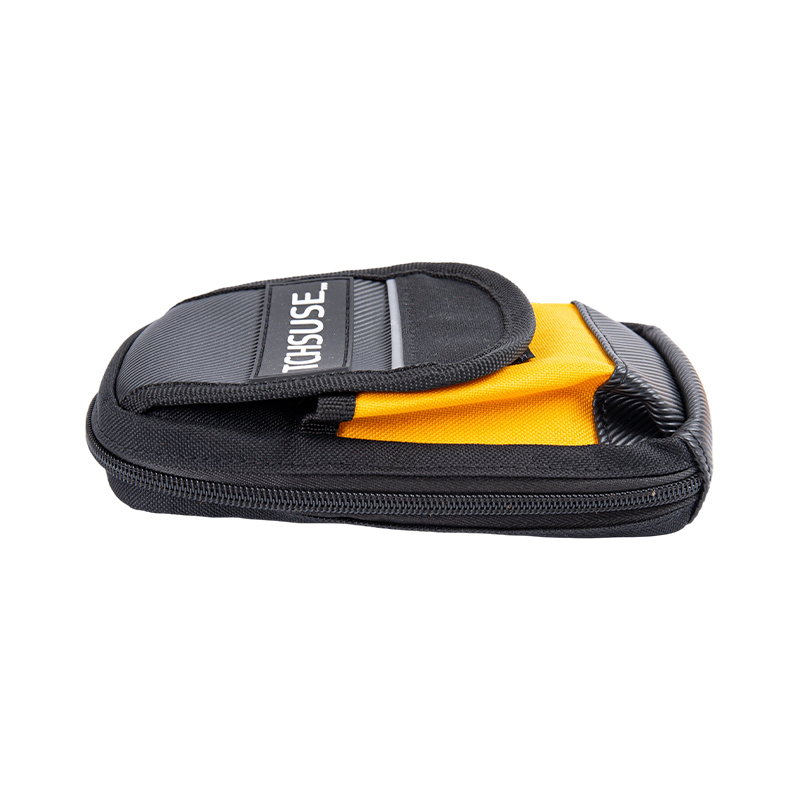 600D Multi-Tool Waist Bag TCHSUSEA compact 600D Oxford waist bag for electricians and maintenance workers, offering secure tool storage and quick access for daily site work.View Product →
For everyday carrying, a compact waist bag with a reinforced base often solves the problem more simply than rebuilding a full belt — fewer pouches, less weight, and far less to adjust each morning.
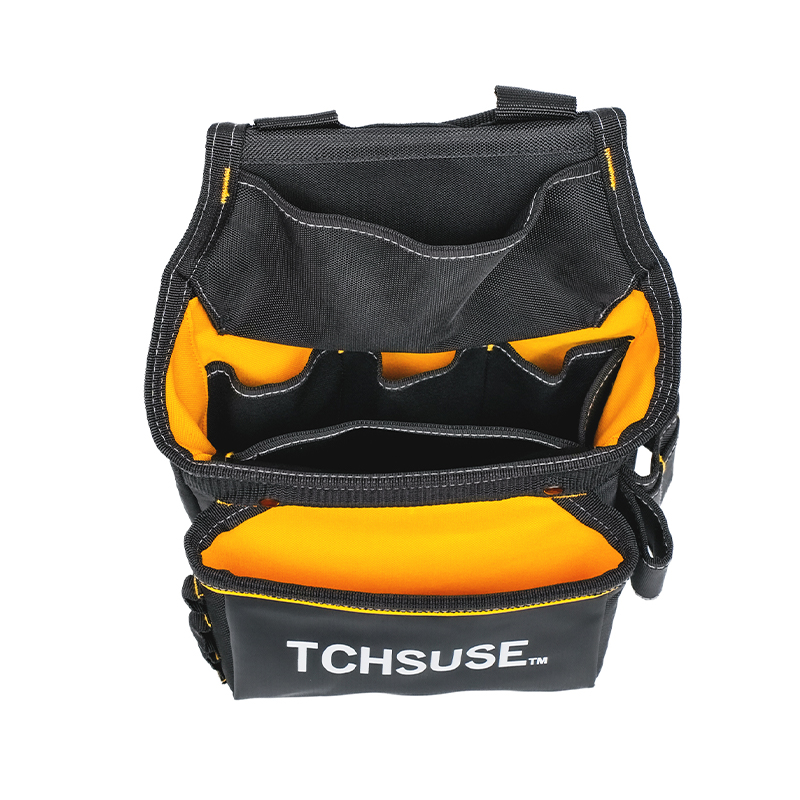 600D Oxford Tool Belt Waist BagThis 600D Oxford waist bag combines a plastic-bottom structure with multi-pocket layout, and the factory supports custom pocket arrangements, materials and branding for sourcing.View Product →
Our own tool belt bags are built in 600D oxford cloth with plastic-bottom structures and multi-pocket layouts, and we produce them in our own factory for distributors and brands that need specific pocket arrangements, materials or branding. If you are sourcing rather than repairing, that flexibility is usually worth more than a catalogue of fixed designs.
Caring for Your Belt So It Keeps Its Fit
A belt that is looked after holds its adjustment far longer. A few habits make a real difference over a season of daily use.
- Empty the pouches at the end of the week so the webbing is not stored under permanent tension.
- Wipe off dust and grit from the clips; grit is what wears the locking surfaces.
- Hang the belt rather than folding it into a bag, which creases the padding.
- Keep the load within the belt's design limits; overloading is what stretches webbing and distorts bases.
Adjusting a tool belt is not a one-time task so much as a short routine you repeat whenever the load or the weather changes. Start with a level, correctly tensioned base belt, put the weight over your hips, keep the tools you use most within easy reach, and bring the suspenders in to share the load. Those four habits will do more for comfort over a long shift than any single accessory.
Related Products

Yancheng Tengchi Tourism Products Co., Ltd. It is dedicated to
designing and producing high-quality tool bags, including
heavy-duty electrician bags.
Experienced staff and experts are always available to provide
you with professional guidance and solutions to technical
problems.
- Product
- Tool Bag
- Tool Backpack
- Capabilities
- Capabilities
- Custom
- About US
- About Tengchi
- Certification
- Quick Connect
- Custom
- Capabilities
- Contact


