
Email: [email protected]

 English
  español
Industry News
Steel Handle Tool Bags: The Ultimate Guide for Professionals
 2026.06.24
 Industry News
A steel handle tool bag is the most durable, stable, and load-bearing option for tradespeople and DIYers who carry heavy tools daily. Unlike fabric or plastic handles that bend, crack, or tear under weight, a rigid steel handle maintains its shape under loads exceeding 50 lbs and resists corrosion, making it the preferred choice for electricians, plumbers, carpenters, and HVAC technicians who need reliable tool transport every day.
This guide breaks down everything you need to know — from construction quality and pocket layout to top-performing models — so you can choose the right steel handle tool bag for your specific work environment.
Why Steel Handles Outperform Other Handle Materials
The handle is the single point of failure on any tool bag. When it gives out, the entire bag becomes unusable. Steel handles address this weakness directly with measurable advantages over nylon webbing, plastic frames, or aluminum alternatives.
| Handle Material | Typical Load Limit | Lifespan (Heavy Use) | Corrosion Resistance | Cost Range |
|---|---|---|---|---|
| Nylon Webbing | 20–30 lbs | 1–2 years | High | $15–$40 |
| Plastic Frame | 25–35 lbs | 1–3 years | High | $20–$55 |
| Aluminum | 40–50 lbs | 3–5 years | Moderate | $40–$90 |
| Steel (Coated/Powder) | 50–80+ lbs | 5–10+ years | High (coated) | $35–$120 |
Powder-coated steel is the standard in professional-grade bags. The coating adds rust resistance while the steel core ensures the frame won't flex or deform when loaded with drills, wrenches, and levels simultaneously.
Key Features to Look for in a Steel Handle Tool Bag
Not all steel handle tool bags are built equally. The following features separate professional-grade bags from budget options that fail within months.
Frame Construction and Gauge
Look for 14- to 16-gauge steel tubing in the handle frame. Thinner gauges (18+) are prone to bending under repeated heavy loads. The frame should be welded, not crimped — welded joints hold under dynamic stress (being dropped, tossed into a truck bed) far better than mechanical connections.
Bag Body Material
The body should complement the steel frame with equal durability. The best materials are:
- 600D or 1680D ballistic polyester — resists abrasion, punctures, and UV degradation
- Canvas (18 oz+) — traditional, breathable, and extremely durable for site conditions
- Reinforced base panels — molded plastic or double-stitched nylon base prevents sagging when the bag sits on wet or uneven surfaces
Pocket Layout and Tool Organization
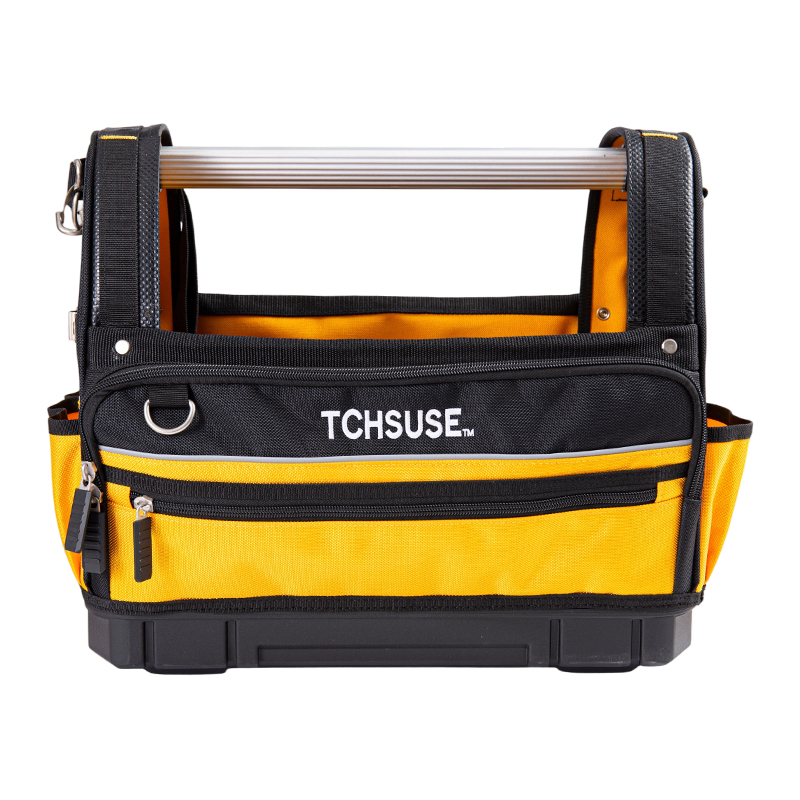
An effective steel handle tool bag for a tradesperson typically includes:
- 1 large central compartment (fits cordless drill, level, or meter)
- 10–30 exterior pockets of varying depth for screwdrivers, pliers, tape measures, and markers
- Rigid interior dividers to prevent tool stacking damage
- Dedicated loops for hammer, utility knife, and flashlight
Handle Grip and Comfort
The steel frame needs a cushioned grip to be usable for extended carry. Look for foam or rubber-wrapped handles, ideally with a non-slip texture. Some models include a padded shoulder strap as a secondary carry option, which is valuable when carrying bags that exceed 30 lbs loaded.
Zipper Quality
YKK #10 zippers are the benchmark for heavy-duty tool bags. Inferior zippers fail within weeks of daily use on job sites. The zipper pulls should also be large enough to grab with gloved hands.
Best Steel Handle Tool Bag Sizes for Different Trades
Choosing the right bag size prevents two common mistakes: undersizing (not enough room, forcing awkward tool placement) and oversizing (dead weight, difficult to maneuver in tight spaces).
| Trade | Recommended Size | Avg. Tool Count | Notes |
|---|---|---|---|
| Electrician | 16–18 in | 25–40 tools | Many small pockets needed for connectors, wire nuts |
| Plumber | 18–20 in | 20–35 tools | Needs deep pockets for pipe wrenches and fittings |
| Carpenter | 18–24 in | 30–50 tools | Large central bay for levels and squares |
| HVAC Tech | 20–24 in | 35–55 tools | Heavy gauges and meters require strong base support |
| General DIY | 14–16 in | 10–20 tools | Lighter load; compact and easy to store |
Steel Handle Tool Bag vs. Tool Backpack vs. Tool Box: When to Choose Each
A steel handle tool bag isn't always the right tool carrier. Understanding where it excels — and where it doesn't — helps you make the best decision for your workflow.
- Steel handle tool bag: Best for frequent movement between job locations, quick tool access, and mixed loads of hand tools and accessories. Ideal when you need to grab and go from a truck or van.
- Tool backpack: Better for climbing ladders, roofing, or any work where both hands must be free. Distributes weight across the body. Slower tool access due to zipper-close design.
- Metal tool box: Best for stationary shop use or permanent truck storage. Not practical for job sites requiring frequent repositioning; heavier and bulkier than a bag.
Many experienced tradespeople use a steel handle tool bag as their primary daily carry and supplement it with a job box or van storage for specialty tools they don't need on every call.
How to Extend the Life of Your Steel Handle Tool Bag
Even a well-built steel handle tool bag will wear prematurely without basic maintenance. Follow these practices to protect your investment:
- Don't overload beyond rated capacity. Consistently exceeding the load limit stresses welds, stretches fabric, and fatigues zipper tracks. If you're regularly maxing out, size up.
- Clean the bag monthly. Wipe the steel frame with a dry cloth to remove metal filings and dust that accelerate corrosion, especially on powder-coated surfaces with chips or scratches.
- Touch up rust spots immediately. Small rust spots on scratched steel can be treated with a rust converter and touched up with spray paint or a rust-inhibiting primer before they spread.
- Lubricate zippers every 3 months. Apply a dry zipper lubricant or beeswax to keep zippers running smoothly. Avoid WD-40, which attracts dirt.
- Store upright, not on the side. Leaving a loaded bag on its side puts uneven stress on the frame and causes pockets to lose their shape over time.
What to Avoid When Buying a Steel Handle Tool Bag
The market is full of bags that look professional but fail on the job. Watch out for these red flags:
- Unspecified steel gauge — if the manufacturer won't specify the frame gauge, assume it's thin.
- Crimped (not welded) frame joints — crimped connections loosen over time and allow frame wobble under load.
- Thin polyester below 420D — will tear at pocket corners within months of daily use.
- No base reinforcement — a bag without a rigid or double-reinforced base will sag and tip over when set down, eventually stressing the bottom seams.
- Generic zippers without branding — non-branded zippers are the first thing to fail on discount tool bags.
Final Verdict: Is a Steel Handle Tool Bag Worth It?
For anyone who works with tools professionally, yes — a steel handle tool bag is worth every dollar more than a basic fabric-handle alternative. The handle is the component that fails first on cheaper bags, and replacing a bag every year costs more over time than investing in one well-built steel frame bag that lasts a decade.
Prioritize frame gauge, weld quality, base reinforcement, and zipper brand when evaluating options — these four factors determine whether a bag makes it through years of real job site use or ends up in a dumpster after one bad winter.
Related Products

Yancheng Tengchi Tourism Products Co., Ltd. It is dedicated to
designing and producing high-quality tool bags, including
heavy-duty electrician bags.
Experienced staff and experts are always available to provide
you with professional guidance and solutions to technical
problems.
- Product
- Tool Bag
- Tool Backpack
- Capabilities
- Capabilities
- Custom
- About US
- About Tengchi
- Certification
- Quick Connect
- Custom
- Capabilities
- Contact



