
Email: [email protected]

 English
  español
Industry News
Open-Top Tool Bag: The Complete Buyer's Guide for Pros
 2026.04.29
 Industry News
If you need fast, unrestricted access to your tools on the job, an open-top tool bag is the most practical choice for most tradespeople, contractors, and DIYers. Unlike zipper-closed bags or hard cases, open-top designs let you grab what you need instantly—no fumbling, no delay. The best ones combine a wide mouth opening, reinforced base, multiple exterior pockets, and durable material (typically 600D polyester or ballistic nylon) to survive daily jobsite abuse. This guide breaks down everything you need to know before buying.
What Is an Open-Top Tool Bag and Who Needs One
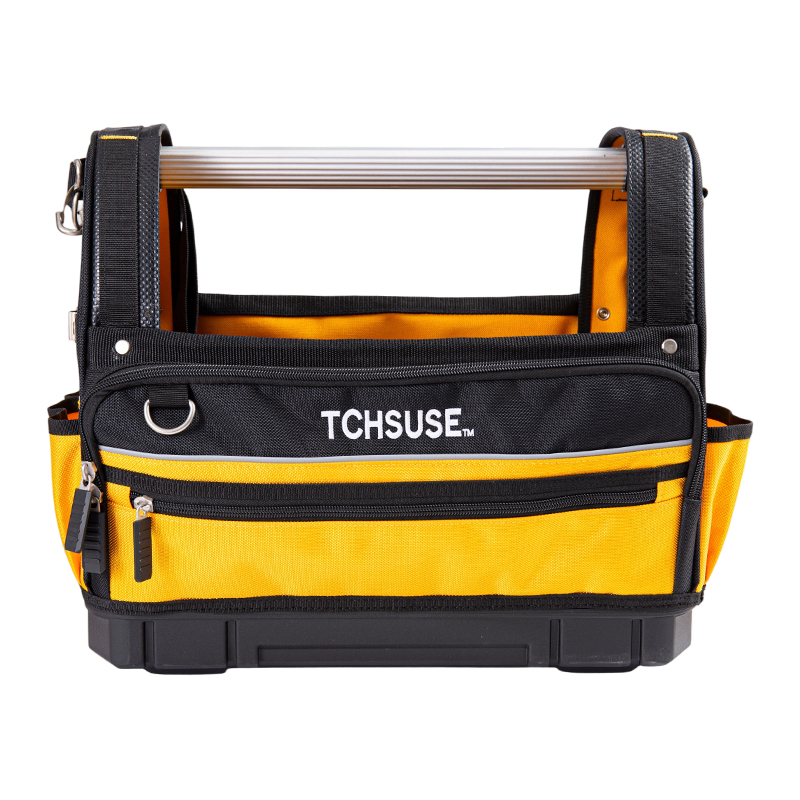
An open-top tool bag is a soft-sided carry bag with no zipper or lid covering the main compartment. The top stays permanently open, giving you a clear bird's-eye view of all your tools at once. Most feature a wide, structured opening held rigid by a metal or plastic frame to prevent the bag from collapsing inward.
They are the preferred choice for:
- Electricians, plumbers, and HVAC technicians who carry a rotating set of hand tools
- Carpenters and general contractors moving between multiple tasks in a single day
- Service technicians who need to identify and pull tools in seconds
- Serious DIYers who own 20+ tools and want organized, portable storage
If you regularly work in environments where time spent searching for tools equals money lost, an open-top bag directly addresses that problem.
Key Features That Define a High-Quality Open-Top Tool Bag
Not all open-top bags are built equally. The difference between a $25 bag and a $90 bag often comes down to these specific construction details:
Material and Denier Rating
Fabric thickness is measured in denier (D). 600D polyester is the minimum acceptable standard for jobsite use; 1680D or 1800D ballistic nylon is significantly tougher and resists abrasion far better. Budget bags often use 300D or lower, which tears within months under heavy tool loads.
Reinforced Base
The base takes the most punishment—being set on concrete, gravel, and wet surfaces constantly. Look for bags with a molded plastic or riveted metal base panel, ideally with rubber feet to prevent moisture absorption and sliding. Bags with fabric-only bases typically fail at the bottom seams within one to two years of professional use.
Frame and Mouth Structure
A rigid or semi-rigid frame around the opening keeps the bag mouth wide open so you can see all tools clearly. Steel wire frames are common and effective; some premium bags use injection-molded plastic frames. Without any frame, the bag collapses when less than half full, defeating the purpose of the open-top design.
Interior Pockets and Tool Slots
The interior walls should have dedicated slots for screwdrivers, pliers, and similar hand tools. A well-designed 18-inch open-top bag will typically offer 20 to 40 individual pockets and slots across the interior and exterior, allowing you to assign every tool a fixed location.
Handle Construction
A fully loaded 18-inch tool bag can weigh 30 to 50 pounds. Handles should be padded, reinforced with webbing that runs under the base of the bag (not just stitched to the sides), and stitched with bar-tack reinforcement at stress points. Handles that attach only at the top panel will fail under heavy loads.
Open-Top Tool Bag Sizes Explained
Open-top tool bags are primarily sold by length. Choosing the wrong size is one of the most common buying mistakes. Here is a breakdown of the most common sizes and their practical applications:
| Size | Best For | Approx. Capacity | Typical Weight (loaded) |
|---|---|---|---|
| 12 inch | Light tasks, electricians, single-trade kits | 15–20 tools | 10–20 lbs |
| 16 inch | General contractors, medium tool sets | 25–35 tools | 20–35 lbs |
| 18 inch | Most tradespeople, full daily kit | 35–50 tools | 30–50 lbs |
| 24 inch | Heavy-duty use, plumbers, large hand tool collections | 50+ tools | 40–70 lbs |
The 18-inch size is the most popular choice across trades because it balances capacity and portability. Going larger makes sense only if you regularly need tools like pipe wrenches, large levels, or reciprocating saws alongside standard hand tools.
Open-Top vs. Zipper Tool Bags: When Each Makes Sense
The choice between open-top and zippered bags depends almost entirely on your workflow. Here is an honest comparison:
- Open-top bags excel when you access tools frequently throughout the day, work across multiple locations, and prioritize speed over security.
- Zipper bags are better when tools need to be protected from dust, debris, or rain, or when the bag will be transported in a vehicle where tools could shift and scatter.
- Many professionals use both: an open-top bag as the primary daily carry, and a zippered bag or hard case for specialized or expensive tools.
One practical consideration: open-top bags should not be stored in vehicles overnight in areas with a high theft risk, since tools are immediately visible through the opening.
Top Open-Top Tool Bags Worth Buying in 2025
Based on construction quality, user durability reports, and value for money, these are among the most consistently recommended options across professional trades:
Klein Tools 5002-18 (18 inch)
One of the most widely used bags in the electrical trade. Features a steel wire frame mouth, riveted base, and 33 pockets. Made from 1000D polyester. Handles are reinforced and rated for heavy loads. Retail price typically falls between $55 and $75, making it strong value for professional-grade construction.
CLC Custom Leathercraft 1539 (16 inch)
A compact, well-organized option built from 600D polyester with a molded plastic base and 50 pockets. Popular among HVAC technicians and service pros who want high organization in a smaller footprint. Priced around $35 to $50.
Milwaukee 48-22-8196 PACKOUT (22 inch)
The premium option for tradespeople already in the Milwaukee ecosystem. Integrates with the PACKOUT modular system, features IP65 weather resistance, ballistic nylon fabric, and a metal frame. At $100 to $130, it is significantly more expensive but designed for extreme daily use and long-term durability.
Stanley FMST530201 FatMax (18 inch)
A mid-range bag with a durable base plate and high-visibility interior. Good balance of capacity and price at around $40 to $60. Well-suited for general contractors and skilled DIYers.
How to Organize an Open-Top Tool Bag Effectively
Owning a good bag is only half the equation. Poor organization negates the speed advantage of the open-top design. Follow these principles:
- Assign fixed locations. Every tool should have one designated slot or pocket. When a tool is used and returned, it goes back to the same spot every time.
- Put most-used tools in interior wall slots. Screwdrivers, pliers, and tape measures should be in the upright interior slots for one-second access.
- Use exterior pockets for consumables. Wire nuts, screws, pencils, measuring tape, and similar small items belong in exterior pockets—not loose in the main compartment where they get buried.
- Keep power tools and accessories in the center floor. Cordless drills, impact drivers, and bulky tools sit in the center base area of the main compartment.
- Audit weekly. Remove tools you have not used in the past week. Unnecessary weight adds up fast; a 40-pound bag carried across multiple job sites adds real fatigue over an eight-hour day.
Common Mistakes to Avoid When Buying an Open-Top Tool Bag
Many buyers regret their purchase within six months due to avoidable errors. The most frequent mistakes include:
- Buying based on price alone. A $20 bag with a fabric base and no frame will collapse, tear, and fail within months under professional loads. The minimum investment for a durable professional bag is around $40 to $50.
- Overbuying on size. A 24-inch bag filled to half capacity becomes unmanageable to carry and harder to organize. Match the bag size to the tools you actually carry daily.
- Ignoring pocket count. A bag with only the main open compartment and no side pockets forces you to put everything in one place, defeating the purpose of organized access.
- Not checking handle attachment points. Inspect where and how the handles are attached before purchasing. Side-only stitching without a full-length base strap is a failure point waiting to happen with heavy loads.
- Skipping the base check. Flip the bag over. If the base is just fabric, pass on it for professional use.
How Long Should a Quality Open-Top Tool Bag Last
With daily professional use, a well-constructed open-top tool bag built from 1000D or higher material with a reinforced base should last five to ten years before significant wear affects function. Budget bags in the 300D to 600D range used professionally typically show serious wear—torn pockets, broken stitching, base failure—within one to three years.
Extending bag life comes down to three habits: not dragging the bag across rough surfaces, drying the bag out after wet-weather exposure before closing or storing it, and not chronically overloading it beyond its practical weight rating. Most manufacturers do not publish official weight limits, but a practical guideline is no more than 35 to 40 pounds in an 18-inch bag for sustained daily use.
Related Products

Yancheng Tengchi Tourism Products Co., Ltd. It is dedicated to
designing and producing high-quality tool bags, including
heavy-duty electrician bags.
Experienced staff and experts are always available to provide
you with professional guidance and solutions to technical
problems.
- Product
- Tool Bag
- Tool Backpack
- Capabilities
- Capabilities
- Custom
- About US
- About Tengchi
- Certification
- Quick Connect
- Custom
- Capabilities
- Contact



