
Email: [email protected]

 English
  español
Industry News
HOME / NEWS / Industry News / Multi-Purpose Tool Bags: How to Pick the Right Size, Material, and Layout for Your Work
HOME > NEWS > Industry News > Multi-Purpose Tool Bags: How to Pick the Right Size, Material, and Layout for Your Work
Multi-Purpose Tool Bags: How to Pick the Right Size, Material, and Layout for Your Work
 2026.09.02
 Industry News
A technician packing a cordless drill, a multimeter, wire strippers, three pairs of pliers, and a box of connectors into an unstructured tote runs into the same problem every morning: the right tool sits at the bottom, under everything else. The fix is rarely a bigger bag. A well-chosen multi-purpose tool bag solves it through four specific factors — pocket layout, fabric denier, base structure, and carrying method. Get those right and one bag handles a mixed load for years of daily use; get them wrong and you pay in torn seams, collapsed bases, and minutes lost on every tool change.
What a Multi-Purpose Tool Bag Actually Is
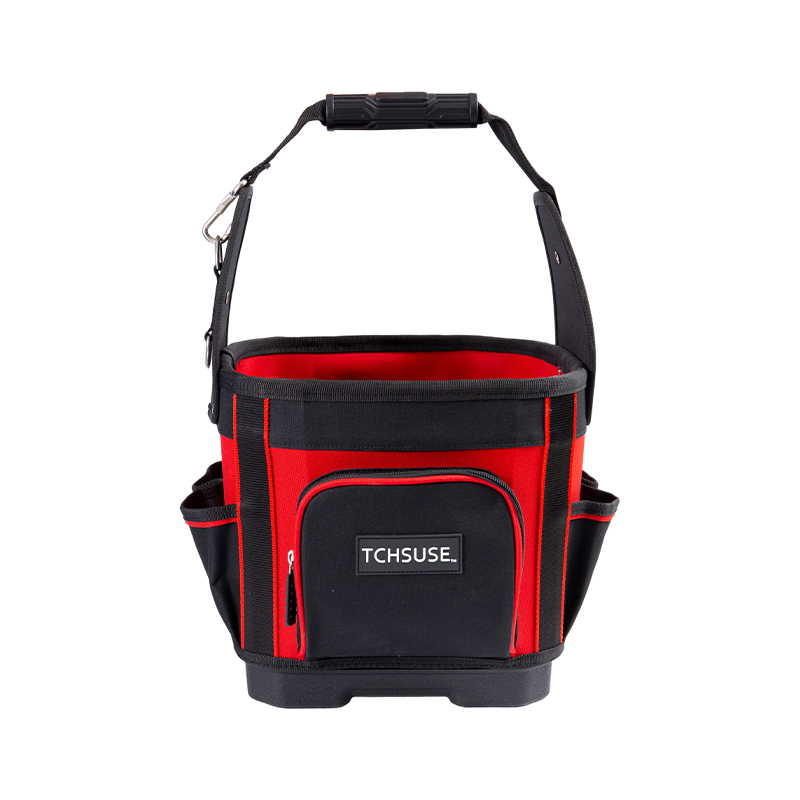
A multi-purpose tool bag is built around mixed loads: hand tools, compact power tools, testers, fasteners, and small accessories carried together in one container. It sits between a simple open tote and a fully specialized trade kit. Three features define the category in practice:
- A wide, stable main compartment sized for bulky items such as drills, crimpers, or small saws.
- Multiple exterior pockets in graduated sizes, so screwdrivers, testers, and tape measures each keep a fixed home.
- Reinforced carrying options — padded handles plus a detachable shoulder strap on most models.
Specialist bags narrow their layout for one trade. A multi-purpose layout deliberately stays broad, which is why it fits maintenance technicians, general contractors, installers, and anyone whose daily tool list changes from job to job.
Size: Match the Bag to the Daily Load
Size is the first decision, and the correct choice depends on the tools you actually carry each day — not the ones you own. The standard ranges break down as follows:
- 11–13 inches: compact service kits. Fits basic hand tools, a tester, and fasteners; stores easily in a van drawer.
- 14–16 inches: the widest fit for general trades. Holds a drill, a full hand tool set, and consumables without becoming exhausting to carry.
- 17–20 inches: full trade loads for electricians and HVAC technicians who carry meters, power tools, and cord runs together.
- 22 inches and up: large-capacity bags that work as mobile storage, usually paired with wheels or a trolley handle once fully loaded.
A practical loading rule: keep total weight within what you can lift one-handed for a minute without strain — roughly 10–12 kg for most adults. A 22-inch bag filled with steel hand tools can pass that limit quickly, which is exactly why the largest sizes pair well with rolling designs.
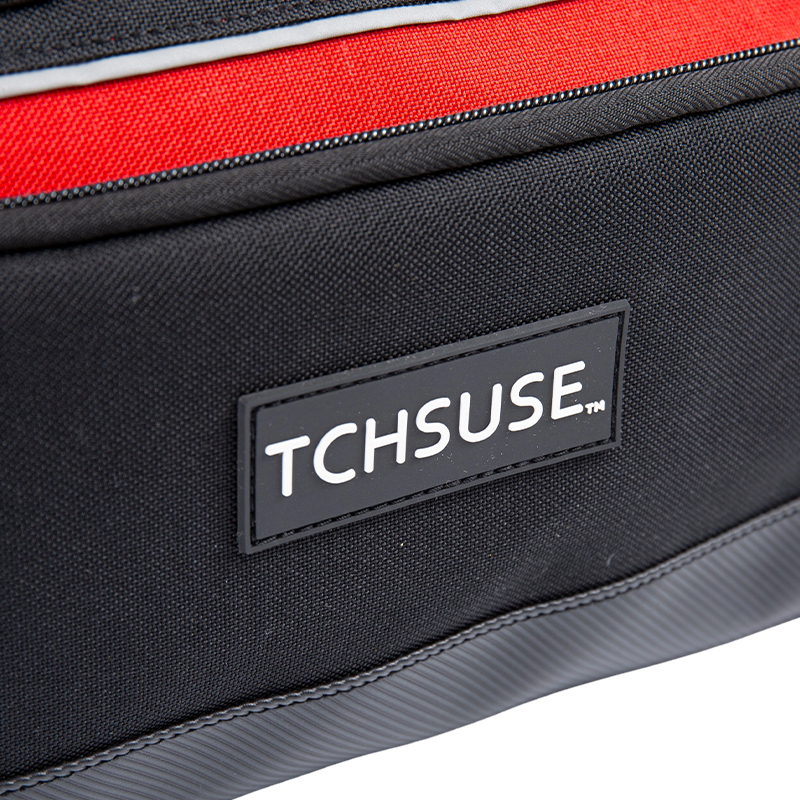 14-Inch/16-Inch 600D Multi-Pocket Tool BagMade of abrasion-resistant, water-resistant 600D Oxford fabric with layered pockets for organized storage. The 14-inch suits portable home repairs, while the 16-inch holds larger tools, fitting the guidance on keeping loads within one-handed carry limits.View Product →
Fabric Denier: 600D, 1200D, and 1680D Explained
Denier measures fiber thickness, and in tool bags it tracks directly with abrasion and tear resistance. Three grades dominate the market:
- 600D oxford or polyester: the standard work grade. Light and cost-efficient, with adequate durability for hand tool loads.
- 1200D: a mid-tier step up, often used on base panels and pockets that take the most contact wear.
- 1680D: heavy-duty oxford with a thicker, tighter weave. The specification for bags dragged across concrete, packed with metal tools, or exposed to sharp edges.
Denier alone does not guarantee service life. Weave tightness, coating quality, and stitch density matter just as much — a 600D bag with double-stitched seams and bartacking at stress points can outlast a poorly sewn 1680D one. When a sample arrives, check the seam construction before anything else, then work the zippers through at least fifty open-close cycles.
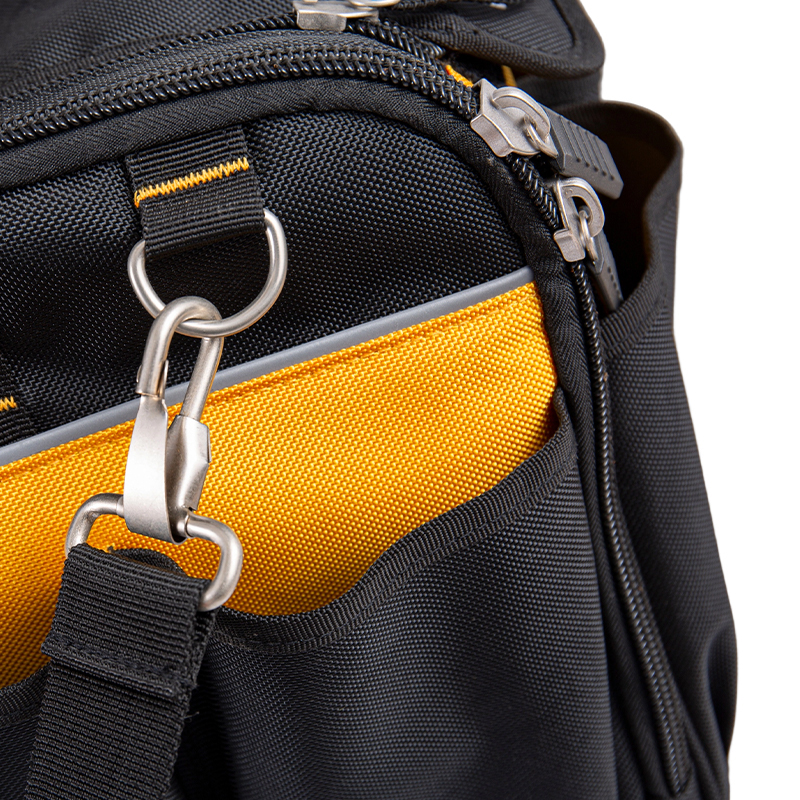 17-Inch/20-Inch 1680D Plastic Bottom Tool BagBuilt from high-strength 1680D Oxford fabric with a hard plastic base that adds structural support, impact resistance, and protection against damp surfaces. Available in two sizes, it suits electrical construction, inspections, and equipment maintenance.View Product →
Base Structure and Opening Style
Two structural details shape daily use more than any other: the base and the top opening.
Why the base matters
A plastic or molded base does two jobs. It keeps the bag upright when set down, and it blocks moisture, grit, and standing water on slabs, gravel, and wet ground. Bags with soft fabric bottoms fail here first — usually at the corners, where the load concentrates and where the bag meets the floor. For outdoor work or unfinished job sites, a molded base is the single most worthwhile structural upgrade.
Zippered versus open-top
A zippered top secures tools during transport and keeps dust out of the main compartment. An open-top layout trades security for speed — every pocket stays visible and reachable without breaking your workflow. Quick-opening designs split the difference: a wide mouth that stays propped open while you work, then closes for carrying.
Handles complete the structural picture. Steel tube handles wrapped in padded grips carry dense loads without the webbing cutting into your hand, and they keep their shape under weights that twist soft handles out of line.
Matching Bag Type to the Job
No single bag covers every scenario, and most working technicians eventually own two. The table below compares the five main types and where each earns its place:
| Bag Type | Common Sizes | Typical Fabric | Best Suited For |
|---|---|---|---|
| Multi-purpose zip-top | 11–22 in | 600D–1200D oxford or polyester | Mixed hand and power tool loads with secure transport |
| Open-top | 11–22 in | 600D–1680D | Fast, repeated access during bench and service work |
| Rolling | 14–27 in | 600D/1680D with trolley frame | Heavy kits moved across large sites or long corridors |
| Steel handle | 17–20 in | Polyester or 600D with plastic base | Dense, heavy loads carried by hand |
| Tool belt bag | Waist fit | 600D oxford | Frequently used hand tools kept on the body |
For most buyers comparing multi-purpose tool bags, the zip-top layout with a molded or plastic base hits the practical middle: secure enough for van storage, open enough for fast work, and reinforced at the point that fails first. Buyers running heavier loads can step up to a large-capacity 22-inch model and add a trolley once weight becomes the limiting factor.
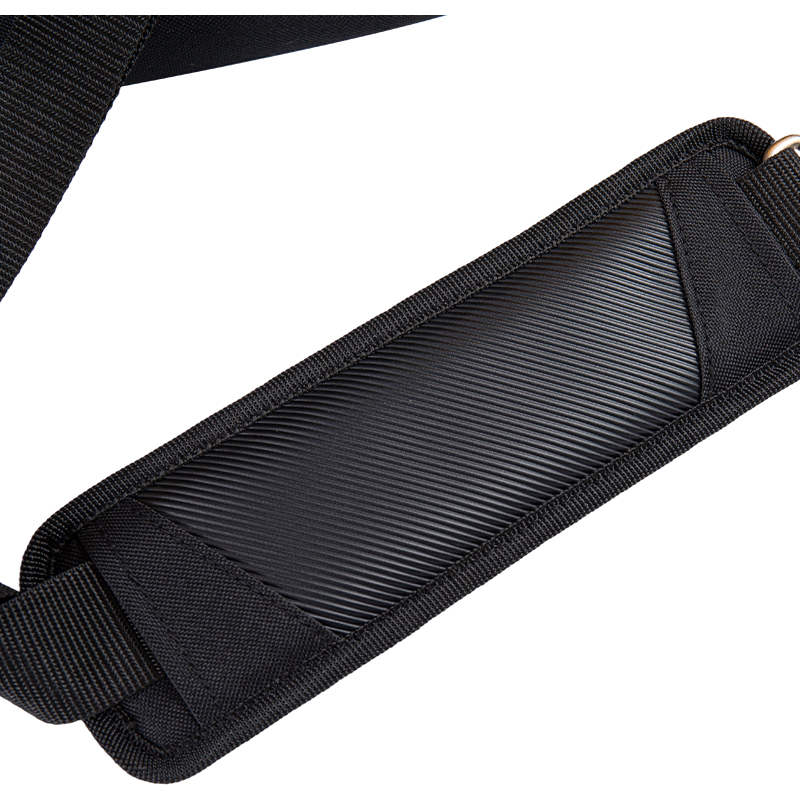 22-Inch 600D Large-Capacity Tool BagCrafted from 600D Oxford cloth with abrasion resistance and water repellency, offering a spacious interior, zippered external pockets, and reinforced handles. Suited to heavier loads where a mid-size bag becomes limiting, as noted for high-volume tool transport.View Product →
What B2B Buyers Should Verify Before Ordering
For distributors and brand owners sourcing tool bags in volume, the evaluation extends beyond product features into supplier capability. Four checks carry the most weight:
- Material verification. Get fabric specifications in writing — denier, coating, weave — and hold the sample against them. A 600D label on thin, loosely woven cloth is a common procurement trap.
- Stitch and hardware testing. Count stitches per inch on load-bearing seams, cycle the zippers repeatedly, and load the handles to at least twice the expected working weight before approving production.
- Customization scope. An established manufacturer treats logo application, pocket layout changes, size modifications, and fabric substitutions as standard OEM work. A supplier who resists small layout adjustments usually has no in-house production line.
- Quality system certification. ISO 9001 registration, together with REACH or ROHS material compliance documentation, sets a baseline for consistent output and smooth export clearance.
A pre-production sample remains the cheapest insurance available in this category. Bulk production amplifies every weakness that survives the sample stage — and eliminates every one you catch early.
The decision comes down to a short checklist: choose a size one step larger than your current daily load, pick 600D for light duty or 1680D for jobsite abuse, insist on a molded or plastic base, and match the pocket layout to the tools you reach for most often. For a step-by-step walkthrough of sizing, materials, and construction, the complete tool bag buyer's guide expands on each of these points. Distributors and brand owners reviewing standard specifications for OEM orders can browse the multi-purpose tool bag category for the full range of sizes and fabric combinations.
Related Products
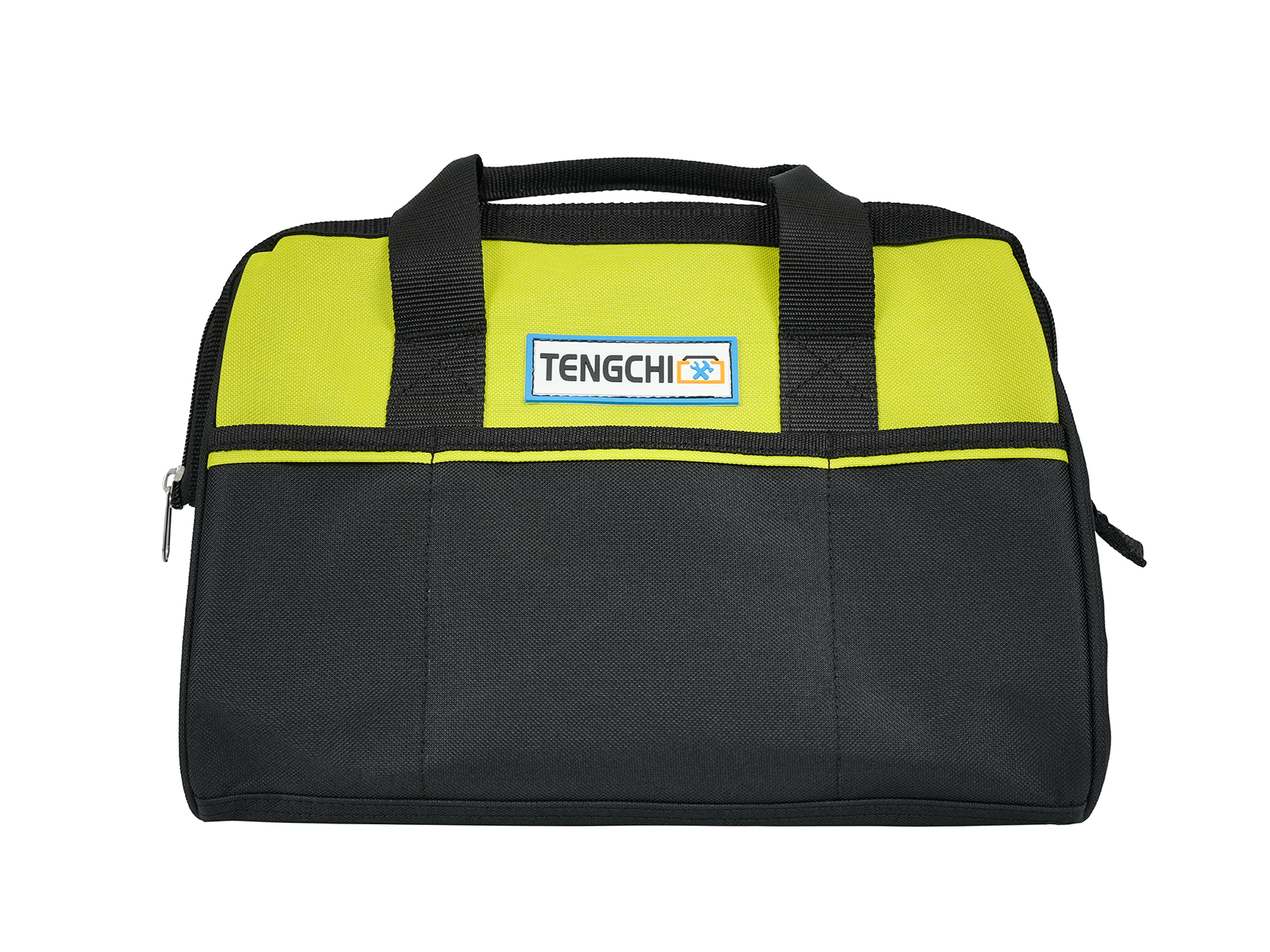

Yancheng Tengchi Tourism Products Co., Ltd. It is dedicated to
designing and producing high-quality tool bags, including
heavy-duty electrician bags.
Experienced staff and experts are always available to provide
you with professional guidance and solutions to technical
problems.
- Product
- Tool Bag
- Tool Backpack
- Capabilities
- Capabilities
- Custom
- About US
- About Tengchi
- Certification
- Quick Connect
- Custom
- Capabilities
- Contact



